Blog post · June 2, 2026 · 6 min read
From Pattern to Pour: Inside the Manufacturing Process Behind a Form Liner Order
The pattern number is the starting point, not the guarantee. Here's what actually happens between your spec sheet and the finished concrete wall — and why each production step controls a specific surface outcome.
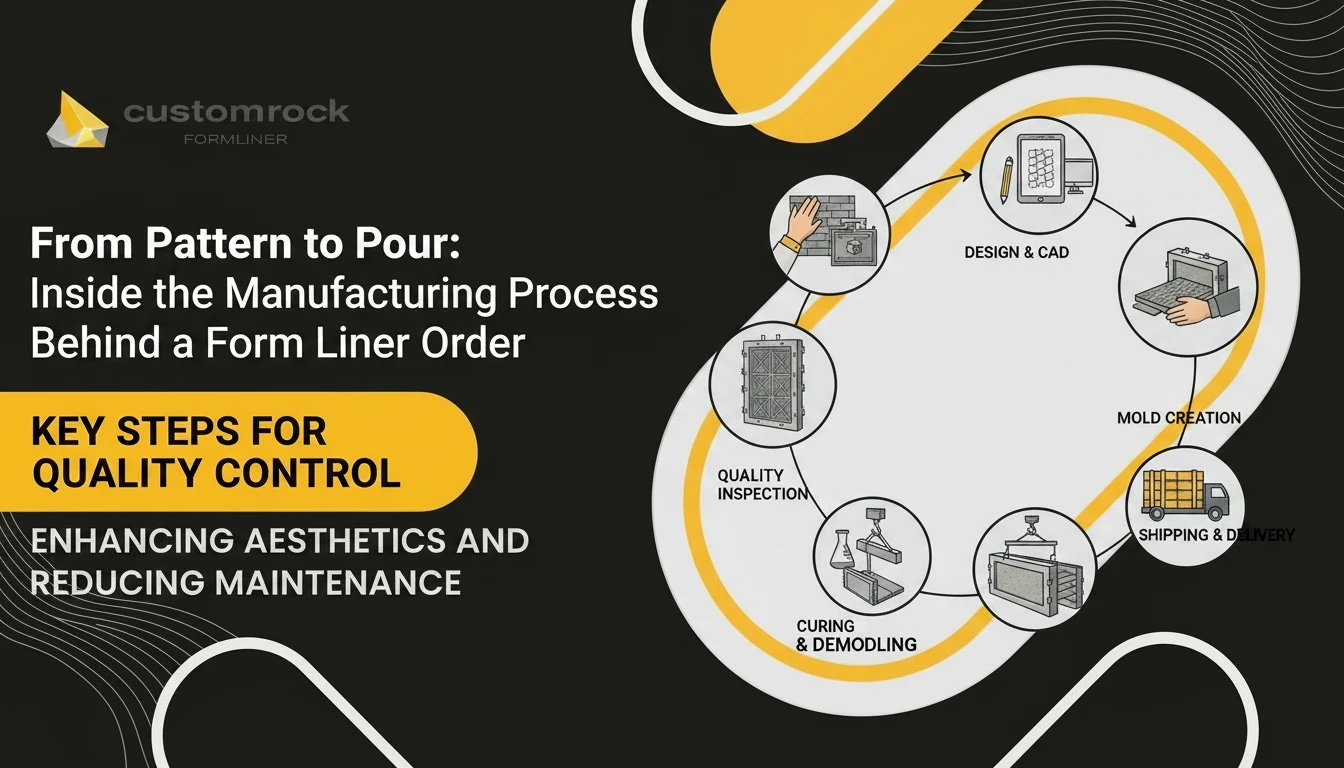
The pattern number on your spec sheet is the starting point, not the guarantee. Architects spend real time selecting the right texture — brick coursing, fractured fins, wood grain — and then hand the spec off to a contractor who orders from a manufacturer they may never visit. What happens between that number and the finished wall is a production sequence that either delivers your design intent or quietly compromises it. Understanding that sequence is the only way to evaluate whether a supplier can actually execute what you've specified.
This is a walk through that sequence, step by step, with the surface outcome each step controls named explicitly.
Material Selection Comes Before Machining, Not After
The first decision in a form liner order isn't which pattern to machine. It's which material to machine it from. Customrock produces two distinct liner types: plastic foam liners suited for budget-sensitive or single-pour applications (typically 1 to 10 reuses), and urethane foam liners engineered for higher detail fidelity and repeat use (up to approximately 100 reuses). These aren't interchangeable. The material choice determines the toolpath parameters, the achievable edge sharpness, and the inspection thresholds applied downstream.
Urethane foam holds finer geometry. That means fluted rib edges stay crisp across dozens of pours, and stone texture depths remain consistent from the first use to the fiftieth. Plastic foam is appropriate where the budget doesn't support urethane and the application doesn't demand that level of longevity. Specifying the wrong material for the application is a process error that no amount of machining precision can fix.
Before a single panel gets cut, incoming foam stock goes through material inspection. Variation in raw material density causes the same programmed toolpath to produce different surface depths on different panels. That's not a machining problem; it's a materials problem, and catching it before machining is the only way to prevent it from propagating through an entire order.
Pattern Origination: Catalog vs. Custom
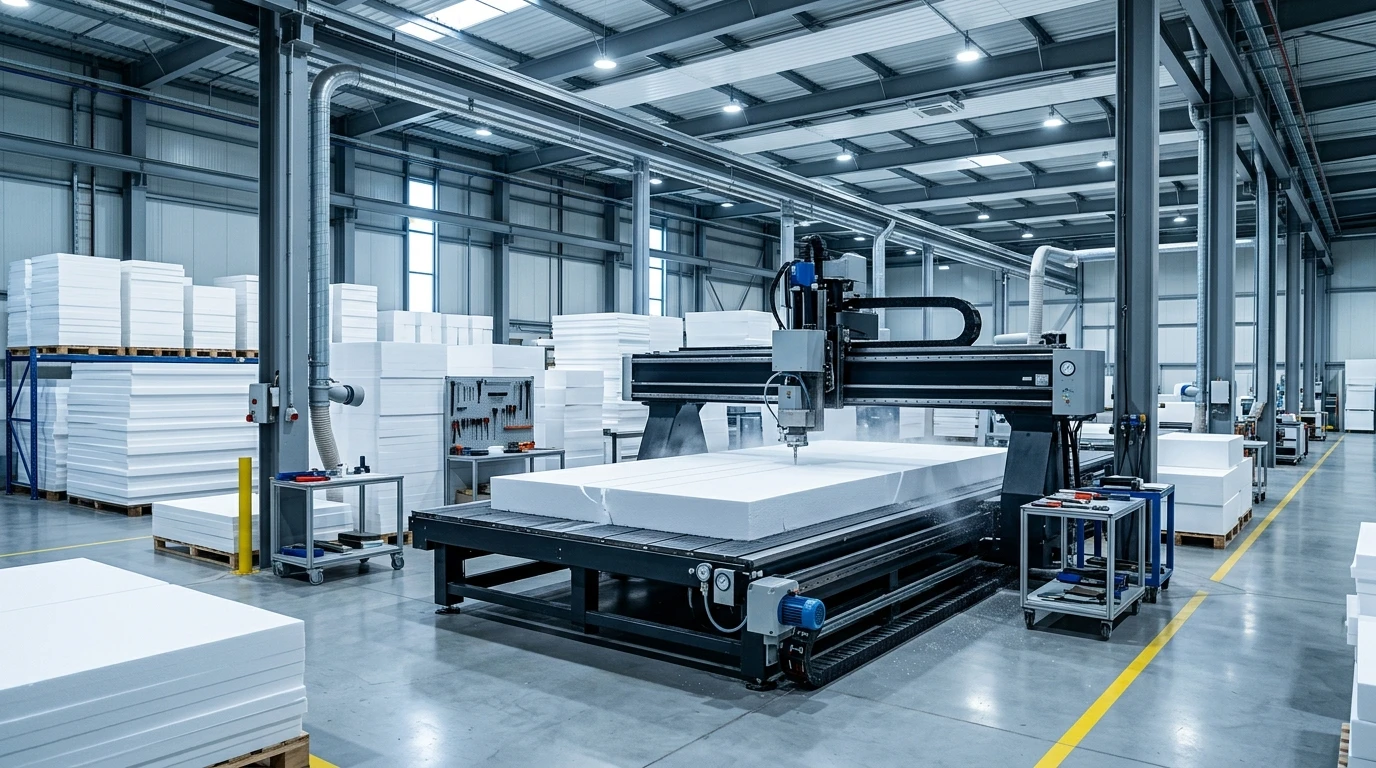
Once the material is confirmed, the pattern geometry has to exist in a form the CNC can read. For catalog patterns (brick, fluted ribs, fractured fins, stone, textured, wood) that geometry is already established. The toolpath is known, the quality benchmarks are defined, and the production sequence is repeatable.
Custom patterns are a different problem. When an architect specifies a pattern that isn't in the standard catalog, or when a contractor needs to match a pattern number from a competitor's catalog, the geometry has to be originated or reverse-engineered from scratch. This is the hardest manufacturing challenge in the process. Replicating a competitor's pattern requires the machining to hit that supplier's dimensional tolerances, not Customrock's own. The finished liner has to seat correctly in existing formwork and produce a surface that reads as continuous with panels from the original supplier.
That capability matters for architects working on phased projects or additions where the original liner supplier is no longer viable. It also reveals something about process maturity: a manufacturer that can replicate variable geometry inputs to someone else's tolerances has a more adaptable and precise production process than one that only runs a fixed catalog. You can learn more about how Customrock has approached custom and catalog work since the company's founding.
CNC Machining: Where the Design Becomes Physical
The toolpath is the most consequential document in a form liner order. It encodes every edge, every depth of relief, every repeat dimension. A correctly programmed toolpath produces consistent geometry across every panel in a run. A poorly programmed one produces surface defects that no downstream inspection step can fully correct, because the defect is baked into every panel cut from that path.
For fluted rib patterns, the critical dimension is edge sharpness. Ribs that are slightly rounded rather than crisp produce shadows that read as soft in the finished concrete, which changes the visual character of the surface at scale. For stone and textured patterns, the critical dimension is depth consistency. Shallow cuts produce flat-looking surfaces; inconsistent cuts produce texture that varies across the wall in ways that read as manufacturing error rather than natural variation.
Each pattern category has its own quality benchmark: edge sharpness for fluted ribs, surface texture depth for stone, coursing geometry for brick. The machining step has to meet the right benchmark for the right pattern, which means quality thresholds aren't universal across the catalog.
Inspection: Per-Panel, Not Per-Order

Most architects visualize a form liner as a single panel. The actual order is 50 sheets or more. A typical urethane order runs $15,000 to $20,000. At that scale, a single out-of-tolerance panel doesn't just fail on its own; it creates a visible discontinuity across hundreds of square feet of finished wall when placed side by side with panels that are in tolerance.
This is why inspection happens per panel, not per order. The goal isn't to catch gross defects. It's to prevent the subtle dimensional drift that only becomes visible at installation. Relief depth, edge geometry, and panel-to-panel alignment all get checked against tolerance before a panel is cleared for packaging.
Surface consistency inspection runs parallel to dimensional inspection. Torn foam cells, machining artifacts, and incomplete cuts are invisible on the liner itself but permanent in the finished wall. A void in the foam surface becomes a ridge in the concrete. A blurred edge in the liner becomes a blurred edge in the structure. These defects don't announce themselves during a pour; they show up after stripping, when there's nothing left to do except document the problem.
The inspection step exists to keep those defects off the jobsite. That's its only function.
Packaging as a Quality Step
Packaging is where form liner quality control typically gets treated as a logistics afterthought. It shouldn't be. A liner that passes dimensional inspection and then gets crushed in transit arrives at the jobsite with the same surface defect as a machining error. Deformed edges produce the same result in concrete regardless of whether the deformation happened in the machine or in the shipping box.
Packaging for form liners has to protect panel geometry through transit and through repeated jobsite handling. Liners get moved, stacked, repositioned, and reused across multiple pours. The packaging design has to account for that lifecycle, not just the initial shipment.
This is a practical point for contractors: inspect liners on delivery, before the first pour. Damage that happens in transit is a supply chain problem with a solution. Damage discovered after stripping is a schedule problem with no good options.
The Dual-Facility Footprint and What It Means for Your Schedule
Customrock operates manufacturing facilities in both Minnesota and Texas. For architects, this is worth understanding as a specification risk-management detail, not just a logistics footnote.
The Texas facility's central U.S. location means shorter ground-shipping windows to the majority of the continental U.S. compared to West Coast manufacturers. When a contractor is working against a pour schedule, a week of extra transit time isn't an abstraction; it's a schedule impact that can cascade into concrete placement delays and associated costs. Central manufacturing reduces that exposure.
The dual-facility footprint also provides regional redundancy for large or time-sensitive orders. A single-facility manufacturer concentrates both production and shipping risk in one location. Two facilities in different regions distribute that risk.
For contractors sourcing a pattern specified by an architect, lead time is often the deciding factor when multiple suppliers can provide the same pattern. Customrock's operational structure is designed to be competitive on that dimension, and the Texas labor cost structure allows for competitive pricing without reducing material grade or compressing inspection steps. The full range of concrete formliner applications Customrock serves reflects the breadth of projects this production capacity supports.
What You're Actually Specifying
When you write a form liner pattern number on a spec sheet, you're not just selecting a texture. You're selecting a production process. The finished wall quality is a function of material consistency, toolpath precision, inspection rigor, and packaging integrity, in that order. The pattern number identifies the geometry. The manufacturing process determines whether that geometry arrives on your wall.
The questions worth asking a supplier aren't just about catalog breadth or price. They're about process: How is incoming material inspected? What are the per-pattern quality benchmarks for machining? How does inspection handle panel-to-panel dimensional consistency across a full order? What does packaging protect against?
A supplier that can answer those questions specifically, not generically, is a supplier whose process has been thought through. That's what you're specifying when you write a pattern number. Make sure the process behind it is worth specifying.