Blog post · June 1, 2026 · 8 min read
The Masonry Look on Infrastructure Projects: What DOT Architects Get Right About Form Liners
Bridge abutments and retaining walls are massive concrete canvases. Here's how DOT architects use stone and brick form liner patterns to integrate structures into their landscape context without adding cost or schedule risk.
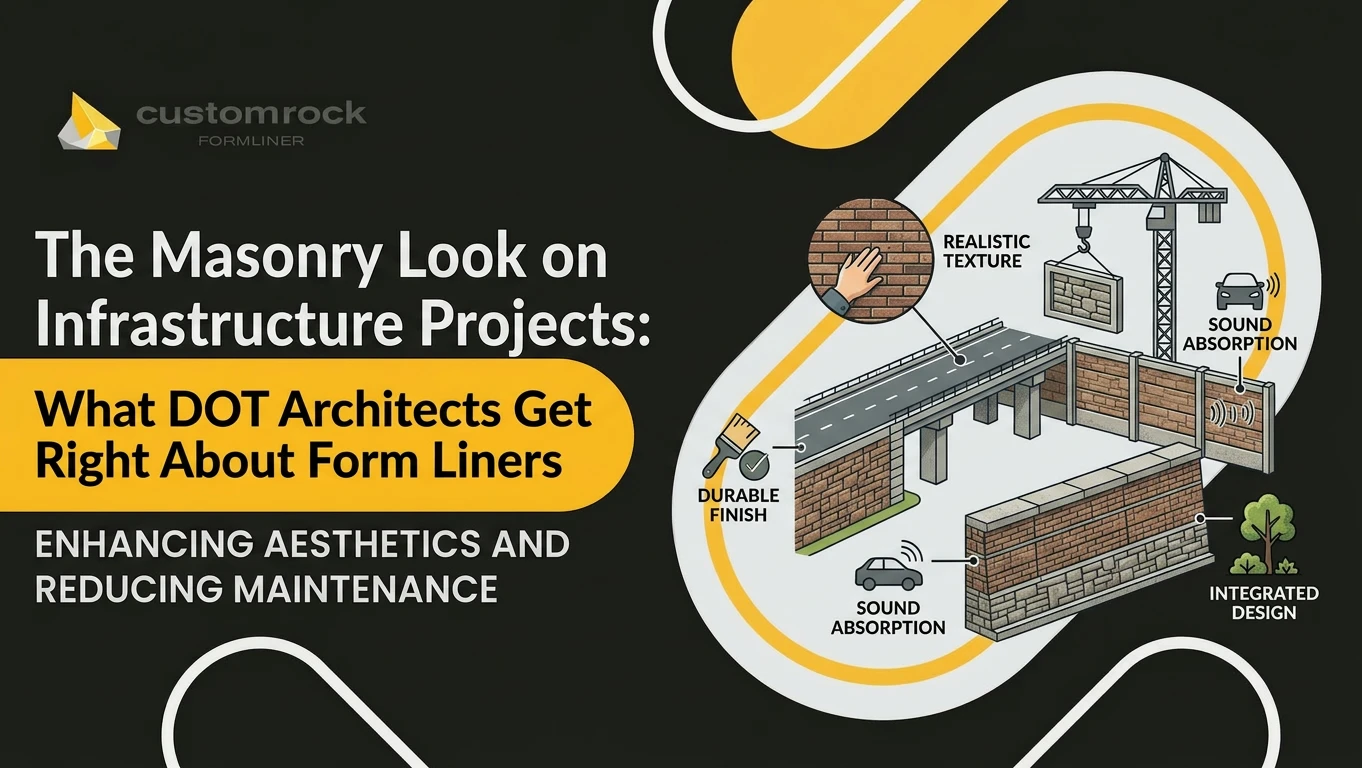
The cheapest finish on a bridge abutment isn't bare concrete. It's a form liner. That claim sounds backwards until you account for what bare concrete costs downstream: graffiti mitigation, community pushback during the next project's public comment period, and the kind of aesthetic remediation that ends up on a change order nobody budgeted for. DOT architects who've been through that cycle once tend to specify texture from the start. The ones who haven't are usually one contentious public meeting away from the same conclusion.
This post is for both groups. It covers the design logic behind stone and brick form liner patterns on infrastructure, the technical factors that actually matter in DOT applications, and how to write a submittal reference that holds up through the contractor procurement chain.
Why Infrastructure Concrete Is a Design Problem Worth Solving
Bridge abutments, retaining walls, and sound barriers are among the largest continuous concrete surface areas in the built environment. A single retaining wall on a highway interchange can run hundreds of linear feet. A sound barrier along a residential corridor can stretch for half a mile. These aren't background elements. They're the dominant visual feature of the landscapes they occupy, and the communities adjacent to them know it.
Sound barrier walls along highway corridors are frequently subject to community aesthetic review. That's not a soft consideration. It's a formal step in the project approval process in many states, which means the surface treatment of a concrete wall carries real stakeholder implications. Pattern selection on these projects is a design decision, not a finishing detail.
The good news is that form liners resolve the core tension of infrastructure design work: the structure has to be functional, durable, and cost-defensible, but it also has to exist somewhere people actually live. Stone and brick patterns deliver the visual weight of heritage masonry materials at concrete cost and schedule. No additional trades, no post-pour finishing steps. The texture is cast in during the pour, transferred directly from the liner to the concrete face.
Stone vs. Brick: Matching Pattern to Landscape Context
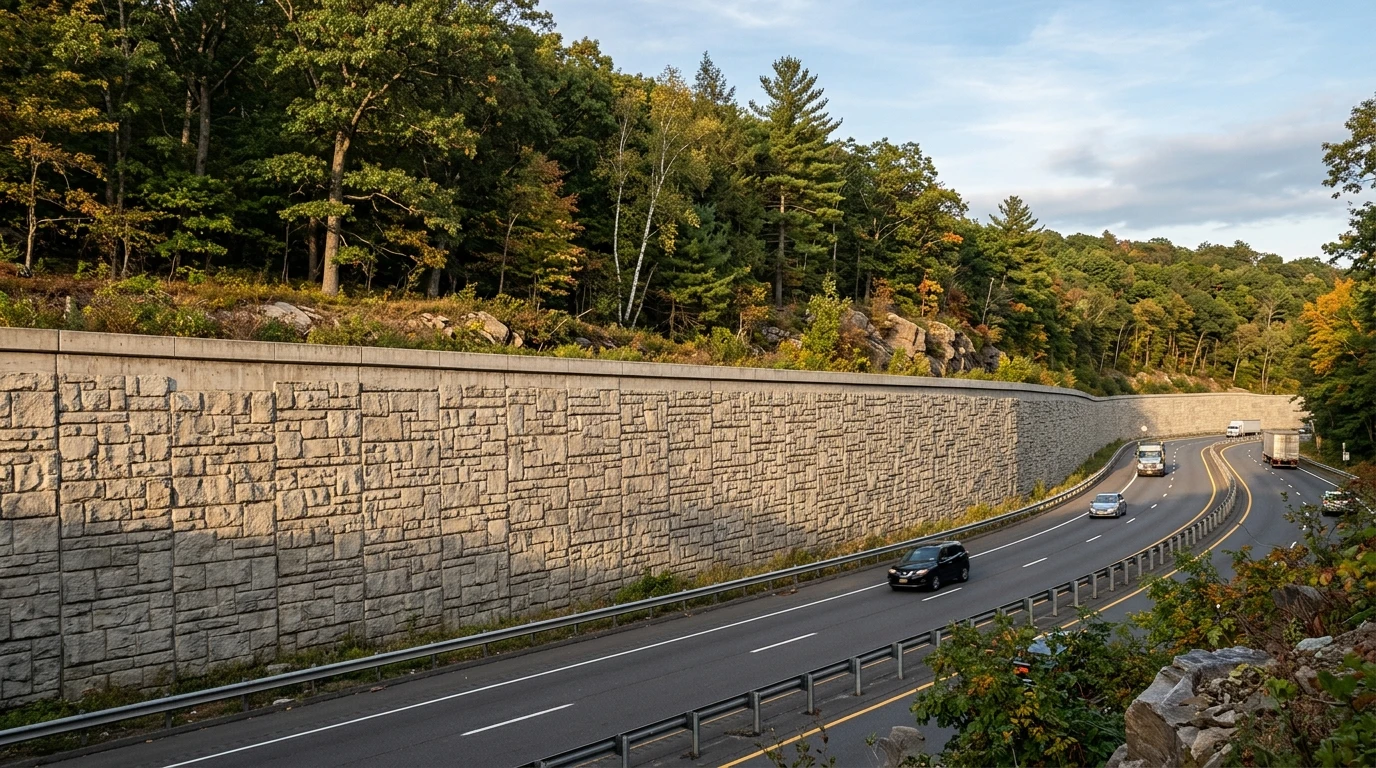
Not all masonry patterns read the same way in the landscape, and experienced DOT architects treat pattern selection as a contextual design discipline rather than a catalog browse.
Fieldstone and coursed rubble patterns work well in rural and semi-rural contexts where the surrounding landscape includes natural rock outcroppings, stone walls, or wooded terrain. The irregular joint lines and varied face texture read as naturalistic, which helps a retaining wall recede into its setting rather than announce itself.
Ashlar patterns, with their more regular coursing and tighter joint lines, suit suburban and urban contexts where the surrounding built fabric includes cut-stone buildings, masonry bridges, or historic infrastructure. The geometry is still recognizably masonry, but it has a dressed, intentional quality that fits a more structured landscape.
Running bond brick patterns are the right call when the structure sits in a context defined by brick: older industrial corridors, urban neighborhoods with brick building stock, transit infrastructure. A brick-patterned sound wall doesn't try to disappear. It tries to belong.
Pattern selection is a regional and contextual judgment, not a default. Architects who treat it that way produce structures that feel considered. Architects who default to whatever's in the standard spec often produce structures that feel like they landed from somewhere else.
Why Urethane Is the Right Material for Infrastructure Applications
There are two form liner material types: plastic foam and urethane foam. For infrastructure projects, the choice is almost always urethane. Here's why.
Plastic foam liners offer one to ten reuses and a lower upfront cost. They're the right tool for one-time or low-repeat pours. On a project where the same pattern needs to be cast dozens or hundreds of times across a long wall run or multiple structures on the same contract, plastic foam becomes the more expensive option at scale. The math is straightforward: if a retaining wall requires fifty pours of the same panel, a liner rated for ten reuses means you're buying the pattern five times. A urethane liner rated for up to approximately one hundred reuses means you're buying it once.
Beyond reuse economics, urethane liners deliver significantly higher pattern fidelity. The sharpness of mortar joint lines, the texture of a stone face, the definition of edge profiles: all of these are more precise in urethane than in plastic foam. On infrastructure projects where the finished wall will be viewed at close range by pedestrians and motorists, that fidelity matters. A blurry stone pattern reads as cheap. A sharp one reads as intentional.
The cost premium of urethane over plastic foam on a large infrastructure project is typically offset within the first ten to fifteen reuses. After that, the urethane liner is delivering texture at no additional material cost for the remainder of the pour sequence. That's the framing that makes sense when you're presenting a spec to a cost-conscious DOT owner.
For a closer look at how these two liner types compare across different project types, the plastic vs. urethane liner breakdown on Customrock's site is a useful reference.
Mix Compatibility and Surface Performance
One question that comes up consistently in DOT applications: do stone and brick form liner patterns work with standard DOT concrete mix designs? The answer is yes, with one important condition.
Form liners are compatible with standard DOT mixes, including mixes with fly ash or slag cement replacements. The liner transfers its pattern regardless of mix design. What does matter is release agent selection and application. The release agent prevents bond between the liner surface and the cured concrete. If it's incorrectly selected for the liner material, or applied unevenly, you get surface defects that compromise both the aesthetic result and the liner's reuse life. This is a contractor execution issue rather than a design issue, but it's worth flagging in the specification and at the pre-pour conference.
On long-term surface performance: UV exposure and freeze-thaw cycling are the primary weathering stressors on infrastructure concrete. The form liner itself doesn't affect the UV performance of the finished surface, but it does affect how weathering reads visually over time. Deeper relief tends to age more gracefully than shallow texture. A stone pattern with pronounced joint depth and varied face relief develops a patina that looks intentional. A shallow texture pattern can look faded or worn in ways that read as deterioration rather than age. For infrastructure applications with a multi-decade service life, specifying a liner with adequate relief depth is a genuine long-term design consideration.
Lead Time Is a Spec-Writing Consideration
Most architects write a form liner spec without thinking about the supply chain behind it. On private commercial projects, that's usually fine. On DOT projects with fixed pour windows, it can blow a schedule.
Public-sector construction schedules are not flexible in the way private projects sometimes are. Pour windows are tied to weather, to traffic management contracts, to downstream trades. A six-week lead time from a supplier on the opposite coast can create a conflict that has no good resolution once the schedule is locked.
Customrock manufactures in Texas and Minnesota. That central U.S. location reduces transit time to project sites across the continental United States compared to West Coast manufacturers. It's not a marketing point. It's a logistics reality that matters when a contractor is working backward from a fixed pour date and needs to know when to place the order.
When writing a form liner spec for a DOT project, it's worth noting the manufacturer's location and typical lead time in the pre-bid documentation. Contractors sourcing the specified liner need that information to sequence their procurement correctly. Architects who've been through a schedule delay caused by liner availability tend to include it. It's a small addition to the spec that eliminates a real risk.
Customrock has been supplying form liners to infrastructure projects since 1971, and the company's background and manufacturing context is worth reviewing if you're evaluating suppliers for a project with tight delivery requirements.
How to Reference Form Liners in DOT Submittals
This is the section most architects want and least often find written down clearly. Here's how to reference a form liner pattern in a DOT submittal.
A complete form liner submittal reference should include four elements:
Manufacturer name. Identify the specific manufacturer, not a generic description. This is what allows the contractor to source the correct product and gives the DOT reviewer a reference point for approval.
Pattern name or number. Use the manufacturer's exact pattern designation. If the pattern is a stone type, include the specific variant (coursed ashlar, random rubble, ledgestone, etc.). Vague descriptions like "stone texture" are not sufficient for submittal approval and create substitution ambiguity.
Material type. Specify urethane or plastic foam. This is a performance specification, not just a material note. It determines reuse capability and pattern fidelity, both of which are relevant to the DOT owner's quality expectations.
Minimum reuse rating. State the minimum number of reuses the liner must be rated for. On infrastructure projects with repetitive pours, this is a quality assurance requirement. A contractor who substitutes a lower-reuse liner mid-project creates a surface consistency problem that's difficult to remediate.
If the specified pattern needs to be sourced from an alternate manufacturer due to lead time or supply constraints, the submittal should require the alternate to match the original pattern's joint depth, face texture, and coursing dimensions. Custom fabrication to match a specified pattern number from another manufacturer is available from Customrock, which reduces schedule risk when the original supplier has capacity constraints.
For the spec section itself, reference the liner requirements under the architectural concrete finish section of the project specifications, not under formwork. Formwork is a means-and-methods specification. Form liner pattern and material type are finish quality specifications. That distinction matters for submittal routing and for contractor accountability.
The Structures That Define a Place
There's a version of this conversation that treats form liners as a cosmetic add-on, a nice-to-have that gets value-engineered out when the budget gets tight. That framing is wrong, and the DOT architects who've worked on the most visible infrastructure projects know it.
The retaining wall along the highway entrance to a town is what people see every day. The sound barrier along a residential street defines the edge of someone's neighborhood. These structures carry real design weight. A stone or brick form liner pattern doesn't add cost in any meaningful sense at the scale of a DOT project. What it adds is the difference between a structure that fits its place and one that doesn't.
If you're specifying form liners on an upcoming infrastructure project and want to discuss pattern options, material selection, or lead time for your pour schedule, Customrock's team is a direct resource.