Blog post · June 2, 2026 · 6 min read
Plastic Concrete Form Liners: Practical Solutions for Large-Scale Projects
Plastic foam form liners are the right call on many large-scale pours — and architects are over-specifying urethane more often than they realize. Here's how to match liner type to project scale, reuse count, and budget.

Most architects who specify urethane form liners on every project aren't making a wrong choice. They're making a habit. And on a single-cycle pour covering thousands of square feet of retaining wall or sound barrier, that habit costs real money without delivering any additional design value.
Plastic foam liners are rated for 1 to 10 reuses. For a large DOT sound wall or a highway retaining wall where the form panels get stripped once and the project is done, that reuse ceiling is completely irrelevant. What matters is surface quality, pattern availability, and whether the liner holds up through the pour and strip cycle. Plastic foam liners deliver on all three.
This post is a practical breakdown of when plastic form liners are the right specification, what changes at large project scale, and what architects need to lock in early to avoid problems in the field.
When Plastic Foam Liners Are the Right Call
The decision between plastic and urethane comes down to one number: how many times will this form be poured?
If the answer is ten or fewer, plastic foam liners are worth serious consideration. If the answer is one, they're almost always the correct specification. The cost difference is significant. A typical plastic foam liner order for a large-scale project runs around 50 sheets and approximately $5,000. A comparable urethane order runs $15,000 to $20,000. On a project where you're pouring once, you're paying three to four times more for reuse capacity you'll never use.
Urethane liners earn their price on projects where the same form will be poured more than ten times. Pre-cast manufacturers running the same panel design for months, or contractors on a long bridge job with repetitive form cycling, get real value from urethane's durability. But for cast-in-place work on infrastructure projects with a defined pour sequence and no repeat cycle, plastic foam is the practical choice.
The visual results aren't meaningfully different to the naked eye on a finished wall. Both material types reproduce pattern detail well, and the finished concrete surface doesn't advertise which liner type produced it.
Pattern Options Are Not Limited at the Entry Level
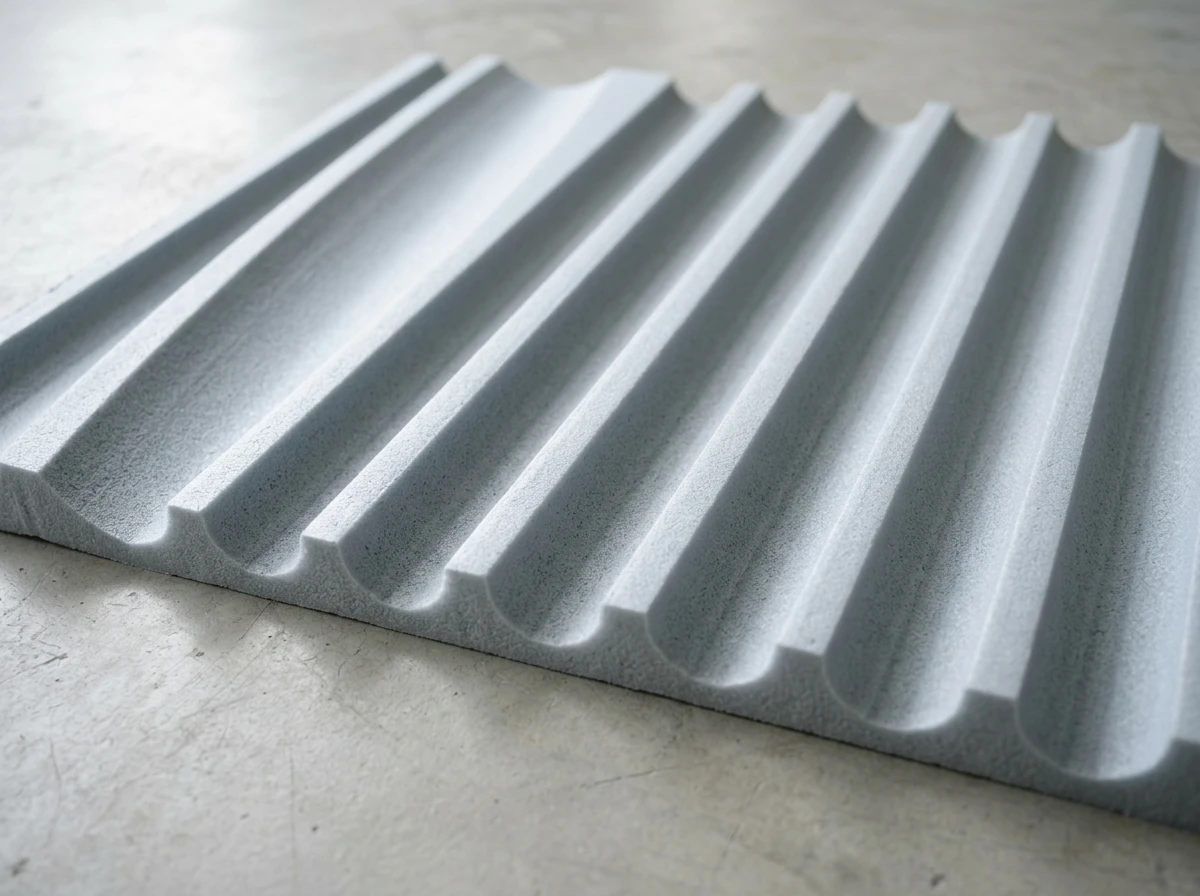
One reason architects sometimes default to urethane is an assumption that plastic foam liners offer fewer or simpler patterns. That's not accurate.
Plastic foam liners are available across the full range of pattern categories: brick, fluted ribs, fractured fins, stone, textured, and wood grain. The same pattern variety available in urethane is available in plastic foam. Architects specifying a fractured fin texture on a bridge abutment or a coursed stone finish on a sound wall have access to those patterns in plastic foam material.
Custom pattern fabrication is also available in plastic foam. If a project spec references a pattern number from another supplier, that pattern can be matched or replicated in plastic foam without requiring a redesign of the specification. That matters on large projects where the pattern has already been approved through an owner or agency review process and changing it isn't an option.
For architects working on projects where texture and pattern variety are central to the design intent, the plastic foam lineup is a full-range option, not a compromise.
What Changes at Large Scale
A 1,000-square-foot pour and a 10,000-square-foot pour are different problems. The liner selection process is the same, but the execution variables multiply.
Sheet quantity and seam management become critical at scale. Plastic foam liners come in sheets, and on a long wall or a wide facade, the joints between sheets will show up in the finished concrete if they're not handled correctly. Architects need to confirm sheet sizing early in the design phase and work with the contractor to plan joint locations intentionally. A seam that falls at a natural break in the pattern reads as a design decision. A seam that cuts across a coursed brick pattern in the middle of a panel reads as an error.
Handling logistics also shift at large scale. Plastic foam liners are lighter than urethane liners, which reduces handling time and labor cost when crews are managing hundreds of form panels across a large jobsite. That weight difference is minor on a small pour and meaningful on a large one.
Release agent application is another variable that gets harder to control at scale. Inadequate release agent coverage is one of the most common causes of surface defects and liner damage during stripping. On a large pour, consistent coverage across every panel is a discipline issue, not just a technique issue. Specifying release agent requirements in the project documents, rather than leaving it to field judgment, is worth doing.
DOT and Infrastructure Projects: A Natural Fit
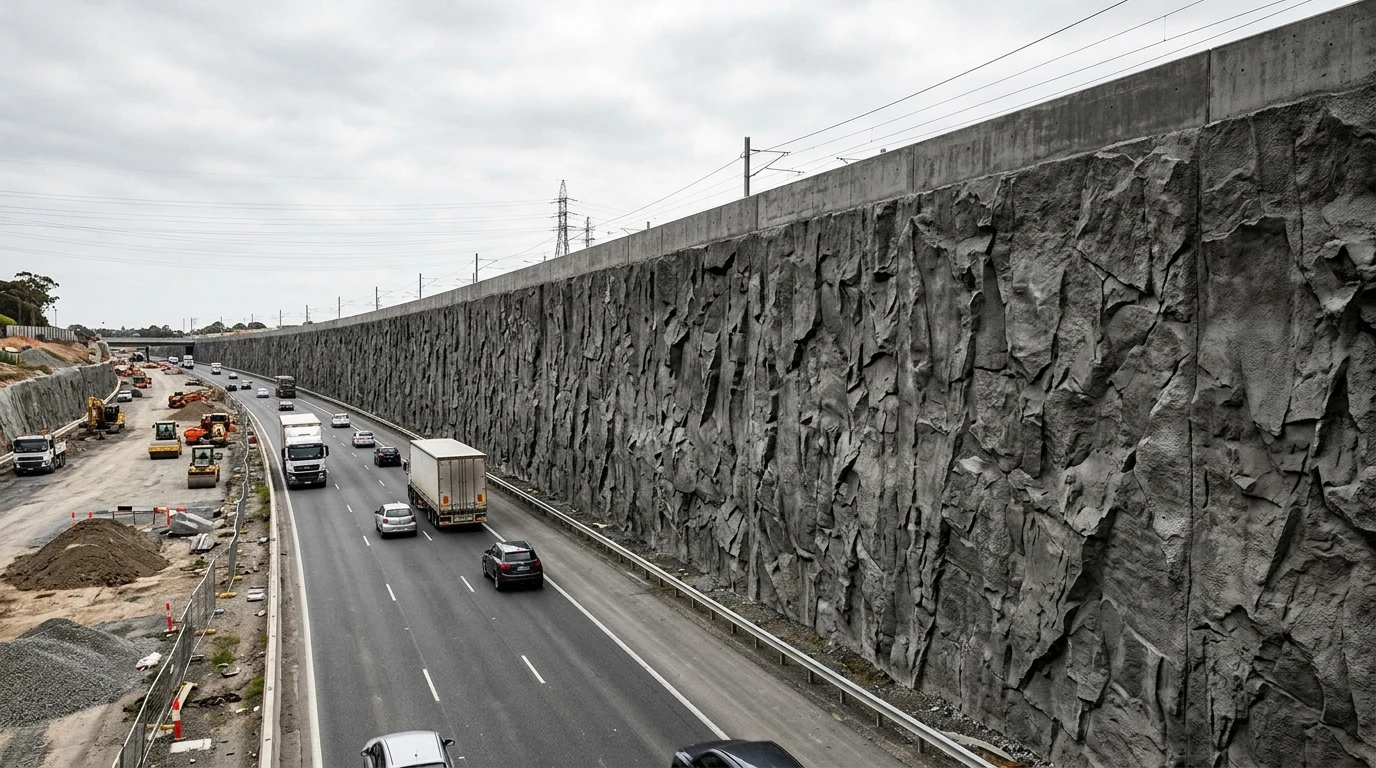
Highway sound walls, bridge abutments, and retaining walls are among the most common applications for plastic foam form liners. DOT infrastructure projects frequently require textured concrete finishes, and plastic foam liners are a code-compatible, well-established solution for these applications.
The procurement timeline on DOT projects makes lead time a real concern. A delayed liner shipment can push back an entire pour schedule on a job where the concrete placement window is fixed by weather, traffic control permits, or downstream construction sequencing. Manufacturing location matters here. Liners produced in the central United States ship faster to most job sites nationwide than liners sourced from the West Coast. That's not a minor logistical footnote on a large infrastructure project with a tight schedule.
For architects at DOT-focused firms, specifying a supplier with central U.S. manufacturing and reliable lead times is part of responsible project documentation, not just a vendor preference.
How to Specify Plastic Foam Liners Correctly
A few things to confirm before the specification is finalized:
Reuse count. Confirm the total number of pour cycles for each form panel. If any panel will be poured more than ten times, flag it for urethane. If the project is a single-cycle pour throughout, plastic foam is appropriate across the board.
Sheet sizing and joint layout. Work with the liner supplier to understand available sheet dimensions and plan joint locations relative to the pattern. This is a design coordination step, not just a procurement detail.
Pattern selection and custom matching. If the pattern is already specified by number from another supplier, confirm that it can be matched in plastic foam before the specification is issued. Custom fabrication is available, but it requires lead time.
Release agent requirements. Include release agent type and application frequency in the specification or the contractor's scope. Don't leave this to field discretion on a large pour.
Delivery schedule. For large orders, confirm lead time against the project's pour schedule. A 50-sheet order is straightforward to fulfill, but it still needs to be coordinated with the contractor's form-setting timeline.
Architects who've worked with Customrock's team since the early days of architectural form liner specification know that these coordination steps go faster when the supplier is involved early. Pattern questions, sheet sizing, and custom matching are all easier to resolve before the spec is issued than after.
The Cost Efficiency Argument, Made Plainly
Large-scale projects already carry significant cost pressure. Sound walls run for miles. Retaining walls cover thousands of square feet. Bridge abutments involve complex formwork. The liner is a small line item relative to the total project cost, but it's not invisible.
Choosing plastic foam liners on a single-cycle large pour doesn't mean accepting a lower-quality result. It means allocating budget appropriately. The visual outcome is equivalent. The pattern options are equivalent. The only thing that changes is the reuse capacity, and on a one-time pour, that capacity has no value.
The architects who specify well on large infrastructure projects are the ones who match material selection to actual project requirements rather than defaulting to the most expensive option as a proxy for quality. Plastic foam liners, specified correctly, are a professional choice. They're not a fallback.
If you're working on a large-scale project and want to confirm whether plastic foam liners are the right fit for your specific pour sequence and pattern requirements, the place to start is a direct conversation with the supplier about sheet sizing, lead time, and pattern availability for your application.