Form liners for concrete walls: tilt wall, retaining wall, and sound wall
What changes when the pour sequence is dozens of panels and the finished wall runs hundreds of feet: seam tolerances, pattern repeat, and reuse economics.
What changes when the pour sequence is dozens of panels and the finished wall runs hundreds of feet: seam tolerances, pattern repeat, and reuse economics.
Direct Answer:
Customrock manufactures plastic and urethane form liners for tilt-up, retaining, sound and cast-in-place walls at facilities in Minnesota and Texas, and fabricates custom corner and cap modules to match spec'd pattern numbers. Form liners for concrete walls solve three problems that do not exist at panel scale. First, seam alignment: Iowa DOT SP-150130 caps misalignment between adjacent liner units at 3/64 inch, which forces the specifier to think about liner sheet dimensions relative to panel joint layout before the shop drawing stage. Second, visible pattern repeat: a texture that reads well on a single panel can produce shadow bands or moiré artifacts across a 400-foot sound wall run. Caltrans RCM Chapter 3 explicitly prohibits repetitive fractured surfaces and secondary shadow patterns. Third, reuse economics: a tilt-up job with 60 identical panels and a sound wall with 200 pours reward elastomeric liners that hold definition through 100 reuses, per Caltrans DIB 88, while a 12-panel retaining wall may not. Corner returns, pilaster transitions, and cap conditions are where wall patterns visually fail if the liner package is not planned as a system. For a primer on what a form liner is and how it works, see the form liner overview.
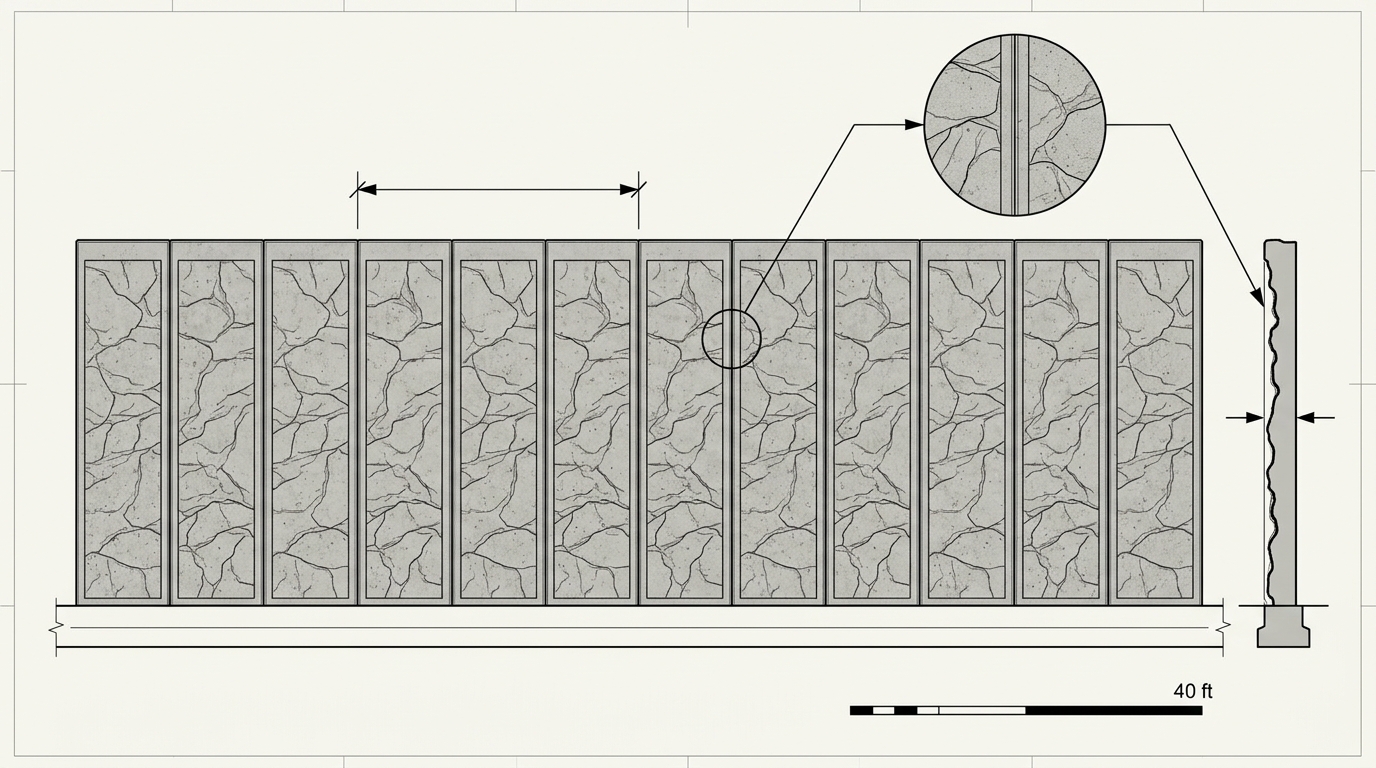
At wall scale, seam tolerance, pattern repeat interval, and corner conditions become spec-level decisions.
What changes when the wall gets long
Iowa DOT SP-150130 caps misalignment at 3/64 inch between adjacent liner units. Across 40 panels that tolerance stacks fast, so liner sheet dimensions have to be coordinated with joint layout in the shop drawings.
The same texture that looks natural on one panel can read as a shadow band or moiré across a long run. Caltrans RCM Chapter 3 prohibits repetitive fractured surfaces and secondary shadow patterns on ribbed textures.
Plastic liners give roughly 1 to 10 reuses. Urethane elastomeric liners hold definition through about 100 reuses per Caltrans DIB 88. On a 200-panel wall the material selection is a cost decision, not a preference.
Standard sheet stock does not wrap corners cleanly. Custom-fabricated corner modules matched to the field pattern prevent flat-finish patches at the most visible junctions on the wall.
Caltrans DIB 88 recommends formed concrete caps to establish a clear border for textures. The liner package should include a cap-compatible section so the texture terminates cleanly at the top course.
Caltrans DIB 88 requires textures to project outward from the structural section, not be recessed. Recessed depth is measured into the wall thickness per RCM Chapter 3 and can violate cover on retaining walls.
Selecting a liner by wall type
Highway retaining walls and mechanically stabilized earth (MSE) wall systems
Bridge abutments, wingwalls, and pier structures throughout highway systems
Highway sound and crash barriers for noise mitigation
Tunnels, underpasses, culverts, and transit system walls
Panel counts are typically 20 to 80 with identical or near-identical geometry. Urethane liners amortize well across the sequence, and vertical patterns need coordination with horizontal reveal joints to avoid conflicts.
NCDOT sets a 4 to 12 foot wall height range with a 3 inch maximum relief depth. Section thickness is measured to the innermost point of the liner per Caltrans RCM Chapter 3, so deep patterns eat cover.
Long continuous pours amplify seam artifacts and require inspection of liners before every reuse per Caltrans RCM Chapter 3. Elastomeric liners are the baseline where DOT aesthetic treatments apply.
Long linear runs at highway viewing distance make pattern repeat the dominant risk. Texture depth also has to coordinate with anti-graffiti coating spec, which limits how deep the recesses can go.
Caltrans DIB 88 mandates commercial elastomeric form liners for aesthetic treatments on bridge abutments and retaining walls. Plastic liners do not meet the reuse and fidelity requirements.
Where the wall is also the finished exterior, thin brick liners let the panel come off the casting bed with a masonry face already in place, avoiding a second-trade veneer sequence.
Plastic vs. urethane at wall scale
DOT spec requirements to build into the wall drawings
Iowa DOT SP-150130 sets 3/64 inch maximum misalignment between adjacent form liner units. Call it out in the aesthetic notes, not just the material section.
Iowa DOT SP-150080 defines depths by type: 0.125 inch for medium sandblast, 0.75 to 1.0 inch for fractured granite and tree bark, 1.25 to 1.5 inches for fractured fins. Pattern selection has to match the band.
TxDOT Item 427 (2024) prohibits liner panel splices that create a noticeable transition or line. Sheet layout has to fall on panel joints, not mid-panel.
Caltrans RCM Chapter 3 requires random texture on raised surfaces between ribs and prohibits secondary shadow patterns. Specify the randomization requirement in writing.
TxDOT SS 4115 references DMS-8111 anti-graffiti coatings. Deep recesses trap coating and complicate cleaning, so pair sound walls with texture depths in the 0.75 to 1.0 inch band or shallower.
Caltrans RCM Chapter 3 measures section thickness to the innermost point of the liner texture on retaining walls. Deep patterns require added wall thickness to preserve rebar cover.
Specifying the wall package
DOT submittals and mockup requirements mean liner selection has to be final before the contractor prices the work. "Or equal" without a pattern number and depth tolerance creates disputes at mockup review.
Vertical patterns on tilt-up panels with horizontal reveal joints create conflicts that cannot be resolved at the pour stage. Lay out the pattern module against the joint grid on the elevation.
Flip and rotate liner sheets across the wall run to break up the natural repeat interval. Note the randomization pattern on the submittal drawings so the contractor does not default to a running bond.
Custom corner modules and cap-compatible sections have longer lead times than sheet stock. Include them in the initial order, not as a change.
On sequenced tilt-up or precast work, map which panels each liner will cast, in order. Caltrans RCM Chapter 3 requires liner inspection before every reuse.
A 4 by 4 foot mockup with the specified concrete mix, release agent, and pull sequence reveals problems that a shop sample will not. Approve it in writing before the panel yard starts.
We will match pattern number, depth band, and corner conditions to what the drawings actually show, and quote against the pour sequence.
Request a QuoteManufacturing in Minnesota and Texas • Custom pattern matching • Nationwide delivery
Caltrans DIB 88 mandates commercial elastomeric form liners for aesthetic treatments on wall structures including bridge abutments and retaining walls. Urethane elastomeric liners hold definition through approximately 100 reuses, which meets DOT reuse and fidelity requirements. Plastic foam liners, which typically yield 1 to 10 reuses, do not meet these DOT specifications.
Iowa DOT SP-150130 sets the maximum misalignment between adjacent form liner units at 3/64 inch on transportation structures. This tolerance is one of the tightest in DOT literature and requires coordinating liner sheet dimensions with panel joint layout during shop drawing review, not at the pour stage.
Sound walls specified under TxDOT SS 4115 reference DMS-8111 anti-graffiti coatings, which perform better on shallower textures because deep recesses trap coating and complicate cleaning. Iowa DOT SP-150080 texture bands in the 0.75 to 1.0 inch range for fractured granite and tree bark textures balance visual depth with coating compatibility.
Caltrans RCM Chapter 3 measures concrete section thickness to the innermost point of the liner texture, not to the form sheathing. On retaining walls, a 1.5 inch pattern relief effectively reduces the wall section by 1.5 inches at every recess, which can violate rebar cover if the wall thickness is not increased accordingly.
Urethane elastomeric form liners can be reused approximately 100 times per Caltrans DIB 88, with clarity and definition maintained across the sequence. Plastic foam liners yield 1 to 10 reuses. Caltrans RCM Chapter 3 requires inspection of each liner before every reuse regardless of material.
Caltrans RCM Chapter 3 prohibits repetitive fractured surfaces and secondary shadow patterns and requires random texture on raised surfaces between ribs. In practice this means flipping and rotating liner sheets across the wall run to break the natural repeat interval, and documenting the randomization pattern on the submittal drawings.
The NCDOT Aesthetic Pattern Book sets a wall height range of 4 to 12 feet and a maximum relief depth of 3 inches for aesthetic form liner treatments on retaining walls. Relief depths beyond this cap create constructability and cover issues on typical wall sections.
Before. DOT submittal and mockup requirements mean the liner pattern, depth, and manufacturer have to be locked at spec time. Writing "or equal" without a specific pattern number and depth tolerance creates disputes at mockup review and delays approval of the first production pour.
Field sheets, corner returns, and cap sections coordinated to the pour sequence. Custom pattern matching available when a legacy pattern number needs to be replicated.
Request a QuotePlastic and urethane liners • Custom pattern fabrication • Minnesota and Texas manufacturing